Underwater Robot · It's Diagnosis
URI-D “NADIA”
An autonomous robot for marine-structure diagnosis. It inspects, maps and builds 3D models on its own.
ROV / AUV HybridOnboard AISurvey-grade navigationAutonomous inspection
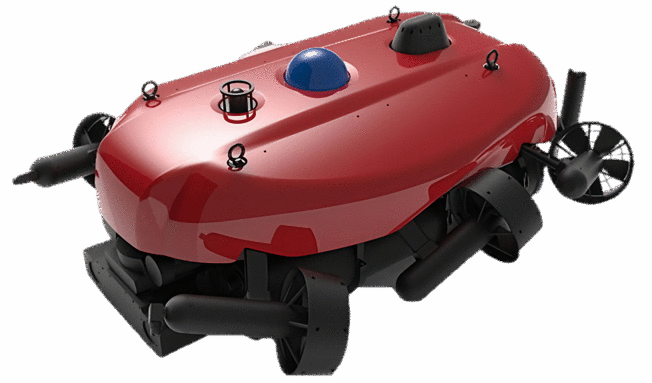
An autonomous robot for marine-structure diagnosis. It inspects, maps and builds 3D models on its own.
Built for 3-D mapping and defect inspection of quay walls, hulls, pipelines and dams — as a tethered ROV or battery-powered AUV.
Recognises and inspects on the robot, in real time.
Clean, well-aligned data for accurate 3-D reconstruction.
Positioning far beyond a typical observation ROV.
| Operation type | ROV & AUV hybrid |
| Operating depth | 100 m |
| Operating time (AUV) | Standard 2 h @ ~1 kn · Extreme 1 h @ ~3 kn |
| Platform size | 0.88 (L) × 1.2 (W) × 0.42 (H) m |
| Platform weight | 70 kg |
| Composite nav accuracy | < 0.5% of range |
| Position accuracy | 0.2 m |
| Attitude accuracy | ≤ 15° |
| Thrusters | Six, vector configuration (holonomic) |
| Onboard compute | GPU AI compute + dedicated navigation processor |
Velocity log, fibre-optic gyro, compass and depth sensing.
Imaging sonar, low-light camera and lighting for turbid water.
Acoustic USBL, plus GPS, Wi-Fi and RF at the surface.
Onboard GPU AI with integrated vehicle control.
URI-D flies the structure, captures imagery and sonar, and turns it into a 3-D model with defects mapped on it.
Camera, sonar and position data, time-aligned.
AI flags defects live and holds distance and coverage.
Tracks coverage to fly complete, gap-free lines.
A georeferenced 3-D model with a defect register.
Ask us about deploying URI-D for your marine-structure assets.
Talk to our engineers →